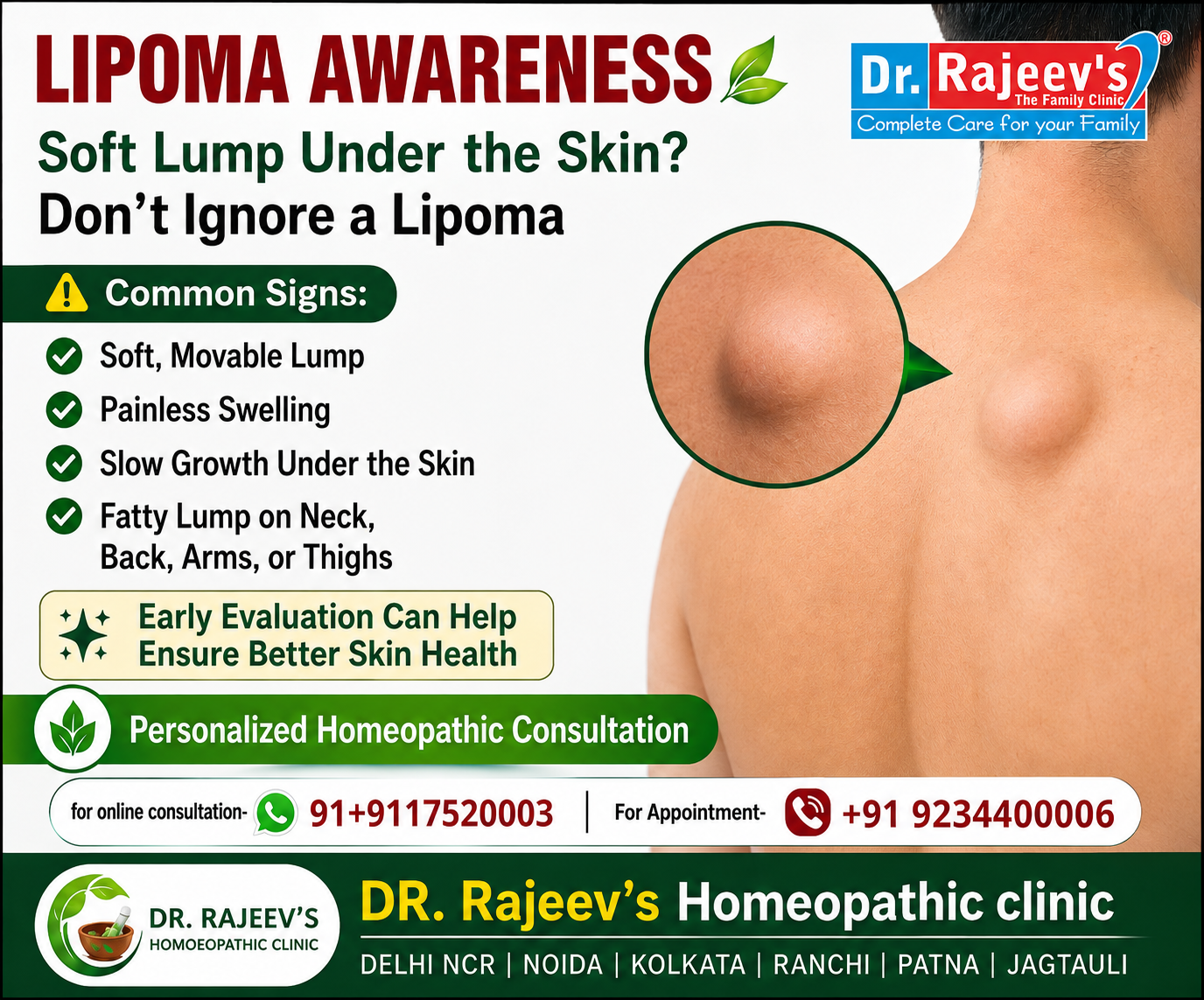
Lipoma is a common non-cancerous growth made up of fatty tissue that develops beneath the skin. Many people notice a soft, movable lump on the neck, shoulders, back, arms, or thighs and become concerned about whether it is dangerous. In most cases, a lipoma fatty lump is benign, grows slowly, and does not cause serious health problems.
Although lipomas are usually harmless, it is important to understand lipoma symptoms, possible causes, and available treatment options. Early medical evaluation helps confirm the diagnosis and rule out other conditions that may appear similar.
Some individuals also explore homeopathic treatment for lipoma as complementary supportive care for overall wellness and skin health. At Dr. Rajeev Homeopathic Clinic, Dr. Rajeev provides personalized homeopathic consultations based on each patient's symptoms, medical history, lifestyle, and overall health while encouraging appropriate medical evaluation when needed.
What Is a Lipoma?
A lipoma is a soft lump composed of fat cells that develops just under the skin. It is considered a benign fatty tumor, meaning it is not cancerous. Lipomas usually:
A lipoma can occur in one area or multiple areas of the body.
Lipoma Symptoms
Many people ask, "What are the symptoms of lipoma?"
Common lipoma symptoms include:
The lump feels soft and doughy.
It can usually be moved slightly with the fingers.
Lipomas tend to enlarge gradually over months or years.
Most lipomas are painless unless they press on nearby nerves.
The lump is often smooth and well defined.
Neck, shoulders, back, arms, abdomen, and thighs are frequent sites.
Seek medical evaluation if a lump grows rapidly, becomes painful, feels hard, or is fixed to underlying tissues.
Causes of Lipoma
The exact cause of lipoma is not fully understood, but several factors may contribute.
A family history increases the likelihood of developing lipomas.
Lipomas are most common in adults between 40 and 60 years of age.
Some lipomas appear after local trauma, although the connection is not proven.
Inherited disorders such as familial multiple lipomatosis can cause multiple lipomas.
Risk Factors
You may be at higher risk if you:
How Is Lipoma Diagnosed?
Doctors diagnose lipoma through:
Discussion of the lump, duration, growth pattern, and symptoms.
Assessment of size, softness, mobility, and tenderness.
Imaging may help confirm a fatty lump.
Used when the lump is deep, large, or unusual.
A tissue sample may be taken if the diagnosis is uncertain.
Lipoma Treatment Options
Many lipomas do not require treatment. Treatment may be considered if the lump is painful, enlarging, cosmetically bothersome, or interfering with movement.
Small, symptom-free lipomas may simply be monitored.
Surgery is the most common and definitive treatment.
In selected cases, fat may be removed through a suction technique.
Homeopathic Treatment for Lipoma
Many individuals seek homeopathic treatment for lipoma because it follows an individualized approach.
At Dr. Rajeev Homeopathic Clinic, Dr. Rajeev evaluates:
A personalized consultation is used to develop an individualized wellness plan.
Important: A lipoma should be properly diagnosed by a qualified healthcare professional. Homeopathy should be considered complementary supportive care and not a replacement for medical diagnosis or surgical treatment when indicated. Any rapidly growing, painful, hard, or changing lump should be evaluated promptly by a doctor.
Natural Skin and Wellness Tips
Healthy habits support overall wellness and healthy skin.
Balanced nutrition supports general health.
Include fruits, vegetables, whole grains, lean protein, and healthy fats.
Regular exercise supports overall well-being.
Do not attempt to squeeze or puncture a lipoma.
Seek medical advice if the lump changes in size, shape, or symptoms.
Can Lipoma Be Prevented?
Because genetics play an important role, lipomas cannot always be prevented. However, maintaining a healthy lifestyle and seeking early evaluation for new lumps can support overall health.
Why Choose Dr. Rajeev Homeopathic Clinic?
At Dr. Rajeev Homeopathic Clinic, we focus on individualized, patient-centered care.
Conclusion
Lipoma is a common benign fatty tumor that usually appears as a soft, movable fatty lump under the skin. Although most lipomas are harmless, proper medical evaluation is important to confirm the diagnosis and rule out other conditions.
Understanding lipoma symptoms, possible causes, and treatment options helps individuals make informed decisions about their health. Surgical removal remains the standard treatment when necessary, while homeopathic treatment for lipoma may provide complementary support for overall wellness and skin health.
If you notice a new skin lump or changes in an existing lump, consult a qualified healthcare professional. For personalized homeopathic consultation and holistic wellness support, visit Dr. Rajeev Homeopathic Clinic.
Frequently Asked Questions (FAQs)
A lipoma is a non-cancerous lump made of fatty tissue that develops under the skin.
Common symptoms include a soft, movable, painless lump that grows slowly beneath the skin.
Most lipomas are harmless and non-cancerous, but any unusual or rapidly changing lump should be evaluated by a doctor.
The exact cause is unknown, but genetics and family history are important risk factors.
Diagnosis is based on physical examination and may include ultrasound, MRI, CT scan, or biopsy if needed.
Lipomas usually do not disappear spontaneously and tend to remain stable or grow slowly.
Surgical removal is the most effective treatment when treatment is required.
Homeopathy may be used as complementary supportive care for overall wellness but should not replace proper medical diagnosis or treatment.
See a doctor if the lump becomes painful, grows quickly, feels hard, changes suddenly, or causes functional problems.
You can visit Dr. Rajeev Homeopathic Clinic for personalized homeopathic consultations and holistic wellness support.


ABHI HOMEO HALL is a one and half decade old renowned clinic that offers the best quality, non-toxic and highly effective treatment in Ranchi, Patna and Delhi.
Read More